All posts by Grace Hield

Helping practices to support patients with serious mental illness

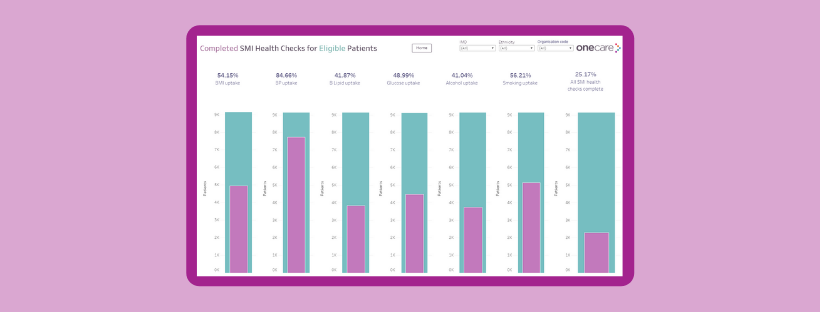
One Care has now added the Serious Mental Illness (SMI) dashboard to its General Practice Intelligence Dashboard (GPID).

As per the local enhanced service (LES), people on the SMI register should receive a full set of six physical health checks over the 12 month period to April 2022.

The dashboard shows the number of people on practices’ SMI register, what proportion have had each of the health checks and how many have had the full set of six required.

Easy access to this data should support practices to focus on where uptake of physical health checks can be improved, which will help maximise on available income and improve patient outcomes.

As with elsewhere in GPID, users are able to filter the data by deprivation decile and ethnic group to further highlight disparities within a group already experiencing many forms of inequality.

Speaking on the SMI dashboard, One Care’s head of business intelligence Rhys Lewis said: “People living with serious mental illness (SMI) face stark health inequalities, including far higher risk of long-term physical health conditions and premature mortality. It is therefore important these patients have their physical health needs proactively met by increasing early detection through physical health checks and follow up interventions.”

“The SMI dashboard enables practices and PCNs to track what proportion of their patients on the SMI register have had each of the six core health checks in the last 12 months and how many are outstanding. By understanding which checks have been undertaken, practices know where they need to concentrate their efforts to maximise benefit for the greatest number of patients.”

“Alongside physical health checks, it is really important these patients are also prioritised for other types of preventative care and early detection, including Covid-19 and seasonal influenza vaccination, and cancer screening.”

If you have any questions about how to access your dashboard, contact onecare.analytics@onecare.org.uk.

‘It’s not OK’: healthcare staff stand together against unacceptable behaviour

Local NHS health and care organisations are repeating calls for people to be kind and respectful, following a rise in violent, aggressive and abusive behaviour towards staff.

Whilst the majority of patients and visitors to healthcare settings are respectful and appreciative, there has continued to be a worrying rise in abusive behaviour during the pandemic.

Healthcare staff know and appreciate that there will be occasions where patients, due to the nature of their condition or through cognitive impairment, may become confused or stressed in unfamiliar environments; which can lead to challenging behaviour. Staff are offered de-escalation training to help deal with these kinds of instances in an appropriate manner.

However, there are many violent, aggressive and abusive incidents which do not involve such patients and can have a lasting impact on NHS staff who deserve to be able to feel safe when they come to work.

A campaign called ‘It’s not OK’ is under way, which features healthcare staff sharing their experiences and urging the public to respect healthcare staff and remember that they’re people, too, following the rise in incidents.

Lizzy Hooper, deputy matron at Yate’s Minor Injury Unit (MIU) says: “I shouldn’t have to be fearful for my team’s safety, yet this is a large part of what I am facing at the moment. We work very hard to ensure people in our care can be safely assessed and supported with their health care needs. It can be very challenging when individuals expect us to be able to see conditions we are not able to treat; we can only see minor injuries less than two weeks old. Some people visiting the department are reluctant to accept there are more appropriate options available to meet their needs. We would ask people to be kind and understand the pressures that we are all facing in these challenging times.”

Hannah Walker, a sister in the children’s emergency department at the Bristol Royal Hospital for Children which is part of University Hospitals Bristol and Weston NHS Foundation Trust (UHBW), said: “Unfortunately, we have seen a significant increase in the number of incidents of violence and aggression displayed towards staff by members of the public. This is not acceptable. It impacts on how staff feel at work and can also be really challenging for other families to witness. Please remember our staff are people too, please treat us with respect.”

Donna Walker, receptionist for Yate’s Minor Injury Unit (MIU), says, “I can feel quite vulnerable while working at the front desk and not knowing who I may deal with every day, particularly when it is really busy. It can also feel very unsettling and demoralising when trying to help a person, only to be yelled at and sworn at along with negative and quite mean comments made towards me and my colleagues.”

Michaela Winkworth, a call handler for the outpatient appointment centre at UHBW, said: “I absolutely love my job as a call handler and find it very rewarding to help patients. Unfortunately, there have been many occasions when patients call and can be verbally abusive and use abusive language. This can make me feel deflated and drained and can be quite stressful.”

Robyn Clark, practice manager at Kingswood Health Centre, said: “There is enormous pressure on the healthcare system at the moment and surgery staff are doing their best to support and assist patients wherever possible. Sadly the amount of abuse being directed at them is still continuing and I have had to write to more patients regarding unacceptable behaviour in the last six months than in the previous four years. Many reception staff are now leaving their roles as a result, making it even harder for patients to get through and obtain the help they need. We want to reinforce that healthcare staff are people too, and patients should treat staff how they would like to be treated in the same scenario. We are all in this together.”

Dr Katrina Boutin, GP at Old School Surgery in Fishponds, says: “Unfortunately, we are still seeing too many cases where patients become violent and aggressive with our clinical or reception staff, which is extremely distressing for them. Staff in GP surgeries are working harder than ever to see and speak to as many patients as we can in the face of extremely high levels of demand.

“We want to make sure that you see or speak to the person who can best help you with your concerns and that we prioritise those who have the greatest clinical need. We understand that this can be frustrating at times if you have to wait longer than you’d like for an appointment, but aggressive or abusive behaviour makes things even more challenging for us. We would really appreciate your patience and understanding.”

There are a number of measures in place to support healthcare staff when experiencing violent or aggressive behaviour from patients; ranging from warning letters and acceptable behaviour contracts to patients being excluded from the premises and, in some circumstances, involving the police.

NHS staff should be able to carry out their work free from the threat of aggressive or abusive behaviour, while being treated with respect and remembering they are people, too.

Supporting new practice staff

A popular programme One Care offers to practices across Bristol, North Somerset and South Gloucestershire (BNSSG) is new staff support.

Launched in April 2020, the new staff support programme consists of six one-hour meetings to new staff joining key roles in the practice – such as a practice manager, partner or lead nurse. These sessions are delivered by our practice support team (PST) and are designed to introduce One Care and the expertise we offer in business intelligence, practice finance, practice operations and more.

Furthermore, the team also offers expertise on working in general practice in BNSSG for those that are new to the area, or are new to the healthcare sector.

One Care have provided ten new staff support programmes to date and a further 15 are currently running across practices and Primary Care Networks (PCNs).

A practice employee who completed the new staff support programme said: “Talking to the One Care experts about practice business, operational and finance management has really helped me to make sense of quite an overwhelming amount of information.”

As well as helping with many different aspects of running practices and offering mentor support to employees, these discussions help One Care to understand the reality and day to day challenges that practices are facing which helps inform and shape the services we offer.

Our One Care Senior Delivery Manager Linda Ruse (nee Buczek) said: “The new staff support programme is very popular and participants consistently tell us how worthwhile they find the support sessions.

“We monitor practice vacancies and contact practices when positions are filled to see if we can help.

“It’s a great opportunity for us to learn about the individual and their respective practice. We develop a positive and ongoing relationship with staff members to ensure One Care helps wherever it can.

“Our practice support team have supported all bar one practice and one PCN in BNSSG, providing more than 300 hours of time and expertise.

“It’s hugely satisfying to help an individual and practice with something they are unsure of, or need more of an insight into, so I would encourage practices to get in touch to see if we can help.”

The new staff support meetings can be virtual, or in-person. The frequency and agenda is very much led by the individual who often has a list of things to discuss. We can also update and answer questions on current BNSSG initiatives.

If you would like more information, please email practice.support@onecare.org.uk.

Resource Publisher improving efficiency

One Care is giving general practices access to the latest referral forms through Resource Publisher (RP).

One Care is responsible for ensuring standardised referral form templates are available to practices and kept up to date, saving time for individual practices as they don’t need to maintain these templates themselves.

RP is a piece of EMIS software, and as a publishing organisation, One Care uses this package to create, update, and share templates and protocols centrally with practices.

To publish resources to a practice, technical data sharing agreements (DSAs) are needed and in Bristol, North Somerset and South Gloucestershire (BNSSG), One Care have DSAs with 99 per cent of practices. One Care also has agreements that allows sharing to Primary Care Networks (PCNs) and each geographical locality.

Reflecting on this achievement, One Care’s Senior Digital Consultant Colette Buckley said: “We are delighted to have reached the milestone of having 99% of practices signed up to receive resources from One Care via Resource Publisher. This will enable us to share a wider range of EMIS resources to practices and PCNs across BNSSG in an efficient and standardised way.”

EMIS-friendly referral form templates are the most commonly published item. However, One Care also creates and shares data entry resources via RP to assist record codes correctly and efficiently, helping improve data quality in BNSSG.

For more information, visit the TeamNet page for RP.

Number of GP appointments rising across BNSSG

Patient contact with GPs in Bristol, North Somerset and South Gloucestershire (BNSSG) continues to increase.

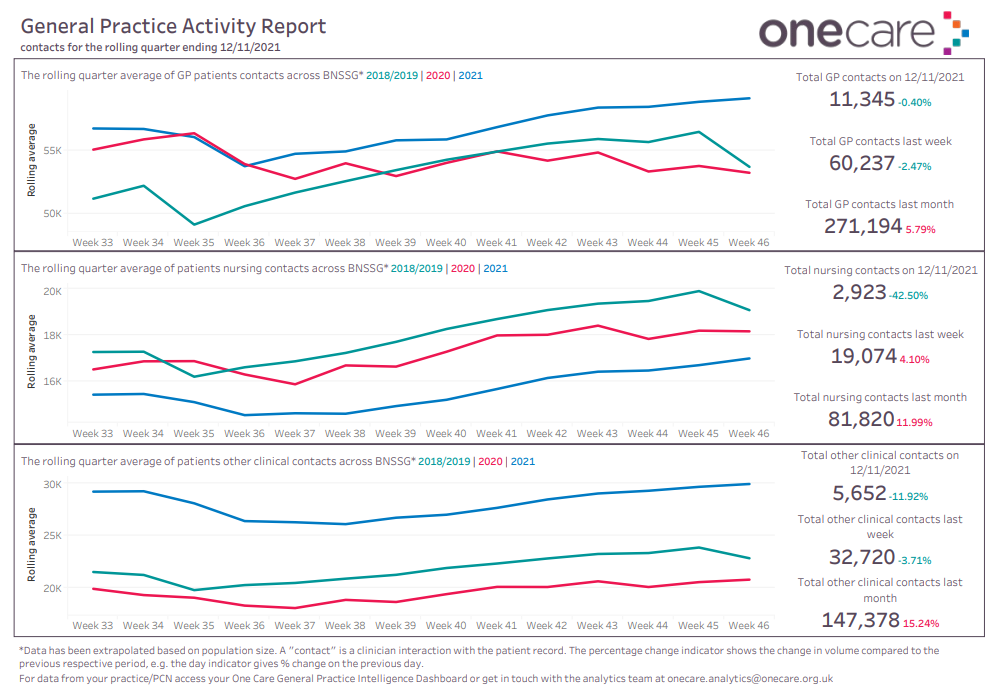
Last week (8-12 November), there were a total of 112,031 appointments across the 77 general practices in BNSSG.

The number of patients to see a GP was 60,237, which is higher than at any point in 2018/19 or 2020. This equates to 54% of all the appointments that took place over the course of the week.

Meanwhile, there were 19,074 appointments with nurses (17% of total appointments) and a further 32,720 with other clinicians (29% of total appointments).

Click here to enlarge the graph.

GPs, their teams, and patients have faced an extremely challenging time during the pandemic and face-to-face contact has been limited across all NHS services to protect patients from the risk of infection.

As the data suggests, not everyone needs to be seen by a GP. All practices offer appointments with a range of other healthcare professionals, and this ensures patients see the right person for their condition as quickly as possible. The general practice team continues to grow, and practices may offer patients an appointment with a physiotherapist, mental health nurse or pharmacist, among others.

To view the latest data around telephone calls, urgent appointments and flu and mass vaccination programmes representing practices across BNSSG up to 12 November, click here.

Receptionists continue to be a key part of the practice team and the questions they ask are to ensure you are seen by the right person at the right time.

This week is national self-care week and doctors and pharmacists in BNSSG are encouraging people to get ‘self-care aware’ by practicing a healthy lifestyle and familiarising themselves with how to treat minor ailments and illnesses at home.

The national campaign aims to help people to better look after their own health – including self-treating very minor illnesses or injuries with help from pharmacists and the NHS website, taking steps to manage long-term health conditions and making healthy lifestyle choices such as exercising and eating well.

Race to Zero campaign

One Care has signed up to the Small and Medium-sized Enterprises (SME) Climate Hub to join the global united national Race to Zero campaign, committed to achieve net-zero emissions no later than 2050.

Small and medium sized enterprises account for 90 per cent of business worldwide and affect the livelihood of two billion people. However, in the global effort to mitigate climate change, large businesses and governments have largely been the focus of the discussion. The SME Climate Hub aims to bring all businesses on board to net zero.

The SME Climate Hub mobilises and supports small and medium sized businesses to commit to cut carbon emissions in half by 2030 and reach net zero emissions before 2050 – a milestone aimed at avoiding the worst effects of climate change while ensuring business viability.

By taking climate action through the SME Climate Hub, businesses can better navigate the shifting expectations of consumers, large corporations, and governments.

Climate action gives SMEs a competitive advantage and enables them to future-proof their business by:

  • Improving efficiencies and reducing costs
  • Managing business risk
  • Enhancing access to capital and affordable insurance
  • Providing unique growth opportunities
  • Building supply chain resilience and
  • Strengthening marketing and branding efforts.

To date, over 2600 SMEs across 84 countries have made the commitment.

For more information on tackling climate change through SME Climate Hub, click here.

Community Phlebotomy successfully rolled out

One Care has been involved in supporting general practice and system partners to develop a new process for taking bloods in community settings. 

Prior to the Covid pandemic, there were 18,000 bloods taken across general practice and acute outpatient departments every week via the North Bristol Trust (NBT) and University Hospital Bristol (UHB) labs, with additional bloods being done at Weston General Hospital.

For many years, general practice has taken outpatient bloods on behalf of secondary care (hospitals), taking responsibility for both the phlebotomy but also the interpretation, communication and risk holding associated with these blood results.

This has been a significant workload for practices, but they have not been contracted to do the work. It is beneficial for patients to have their bloods taken in general practice as it means they can access care closer to home.

The community phlebotomy programme – otherwise referred to as secondary care bloods – has sought to address the governance of this work, ensuring blood results are returned to the requester in secondary care and to properly resource general practice to deliver this service. Over the last year primary and secondary care have been working together, supported by the CCG, to establish a standard process for this, putting patient experience and safety at the heart of the programme. This collaborative approach saw general practice and the trusts working as equal partners in the design of this new way of working.

The community phlebotomy service was fully launched on 31 October after a soft launch on 1 July, which saw primary and secondary care all working to the same standard operating procedure. Primary and secondary care will continue to work together with the CCG in this new phase of the programme to ensure a smooth transition into this new way of system working and to scope out further potential for development.

One Care have been well placed to support practices in the programme’s development due to the trusted relationships already established with practices.

As an integral part of the working group, One Care was involved in the first aspects of building up the business case for the programme, including initial data collection to confirm phlebotomy volumes and negotiating an item of service fee so practices were sufficiently remunerated for the work.

Throughout the programme, which has supported the outpatient transformation in a clinically safe, understood, and funded way, One Care has provided support for practices, in the form of regular communications, training for practice staff, trouble-shooting issues practices are having and developing EMIS resources to support the programme.

The next steps will see One Care analyse the data being collected to monitor the numbers of secondary care bloods being done in primary care and develop a dashboard to present this information back to practices. This data will also be used to monitor the success of the programme and will highlight any areas for improvement.

GP Collaborative Board Coordinator Rosie Southwell said: “A huge thanks goes to Nicola McGuinness (GP Collaborative Board lead) and Geeta Iyer (CCG Primary Care Development Clinical lead) for their leadership in the programme.

“It’s been really inspiring to see how general practice can influence positive change in the system when we come together with one voice. This has been one of the first programmes of work driven forward by our newly formed GP Collaborative Board.

“Practices have been really supportive and engaged throughout the programme – the feedback we’ve received has been extremely encouraging.

“We have lots of learning to take forward into the future as partners across our system begin to work even more closely together in an Integrated Care system. This is a great example of what can be achieved when we work collaboratively to find a solution that works for our population.”

Self-care for better health and wellbeing

During national Self-Care Week (15-21 November 2021), doctors and pharmacists in Bristol, North Somerset and South Gloucestershire are encouraging people to get ‘self-care aware’ by practicing a healthy lifestyle and familiarising themselves with how to treat minor ailments and illnesses at home.

The national campaign aims to help people to better look after their own health – including self-treating very minor illnesses or injuries with help from pharmacists and the NHS website, taking steps to manage long-term health conditions and making healthy lifestyle choices such as exercising and eating well.

Local GP Dr Jonathan Hayes is chair of the Bristol, North Somerset and South Gloucestershire Clinical Commissioning Group and is backing the campaign. He said: “Self-care and knowing how to look after our physical and mental wellbeing is a vital skill that we can all learn and it’s especially important at this time of year as we approach winter when staying healthy is so important.

“We already practice self-care by brushing our teeth, exercising and wrapping up warm during cold weather, but self-care can also include treating minor ailments at home and managing long-term conditions like diabetes or asthma with advice from your local pharmacist or family doctor.

“Fortunately there is wealth of advice and information out there to help people do this – and better still, by practicing self-care, people can help doctors, nurses and other professionals to care for those who really need their skills and expertise.”

This year’s campaign theme is ‘Practise Self Care for Life’ with a focus on developing long-term self-care habits for a happier, healthier life.

Here are seven top tips for better self-care this winter:

1. Get the right advice

Self-care advice and help with treating very minor ailments is available from your local GP and pharmacist as well as the NHS website and the Self Care Forum.

For parents of young children, there’s the NHS HANDi App which gives parents specialist, up-to-date advice on common childhood illnesses and how to treat them. You can download it free for all smartphones.

This winter children’s charity Barnado’s has also introduced a new multilingual helpline offering advice about respiratory illnesses in children aged 0-3 for parents/carers from Black, Asian and Minority communities. Parents/carers can call the Boloh helpline on 0800 151 2605.

2. Talk to a pharmacist

With over 150 pharmacies across the area, you’re never far from a pharmacy and they’re a great source of expert advice on a wide range of winter illnesses. Community pharmacists are qualified healthcare professionals who can offer clinical advice as well as over-the-counter medicines.

Pharmacies are open throughout the day, evening and on weekends and you can be seen without an appointment. All pharmacies have a consultation room so you can discuss your queries and concerns in a private setting if you need to.

3. Keep a well-stocked medicine cabinet

Minor illnesses like coughs, colds, headaches and diarrhoea can quite easily disrupt your daily life if left alone. You can help yourself (and your family) feel better or recover at home if you have the right variety of medicines to hand.

Your community pharmacist will be able to advise you on the best options, and importantly which products are suitable for children.

4. Manage long-term conditions

Self-management helps people with long-term conditions like diabetes, arthritis or asthma to take control of their treatment by finding out more about their condition, learning skills to manage their health and working in partnership with their health team.

For example, your GP can help you develop an action plan and your pharmacist can also help with a medication review.

The Patients Association has more advice on self-management of long-term conditions.

5. Reduce alcohol intake and give up smoking

Stopping smoking and reducing your alcohol intake is a powerful way to self-care for the long term and minimise your chances of a wide range of health problems.

See the NHS Quit Smoking or Alcohol Support websites for more information.

6. Stay active

Whatever your age, there’s strong evidence that being physically active can help you lead a healthier and happier life. Try to be active every day and aim to achieve at least 20 minutes of physical activity per day through a variety of activities. See the NHS Get Active web pages.

7. Eat well

Eating a healthy, balanced diet is an important part of maintaining good health and can help you feel your best. This means eating a wide variety of foods in the right proportions and consuming the right amount of food and drink to achieve and maintain a healthy body weight – see the NHS Eatwell Guide for more advice.

One Care support for our practices between July and September 2021

We have published our latest quarterly round-up of strategic changes, information about new One Care projects and a one-page infographic showing the direct support we’ve provided to practices.

This year has continued to be extremely challenging and pressured for the NHS, including in general practice. In early August, One Care reinstated a situation reporting process which our practices could use to escalate any workforce and workload issues they were facing. This enabled One Care to contact practices in need of support throughout August and September, leading to several new guides and tools being published, including the development of the practice activity graphics in the General Practice Intelligence Dashboard.

Through One Care’s new staff support service, twenty-one new members of staff have had their induction to Bristol, North Somerset and South Gloucestershire (BNSSG) general practice. This is a brilliant opportunity for those who are new to general practice or to the area to get a feel for the landscape they will be working in and to understand what One Care can offer to their practice or PCN.

Click to enlarge infographic

This year, we have provided a range of resources to support practices with managing flu season. This included EMIS searches and protocols, which were published earlier than in any previous year. We also launched the improved flu page in the General Practice Intelligence Dashboard. This year’s data will be updated twice a week and reports on additional cohorts aligned to the 21/22 Investment and Impact Fund indicators.

One of One Care’s key priorities for this financial year is to develop a longer-term subscription model for the organisation that is separate from improved access. We will move to this new model from April 2022. As part of this work, we need to identify current and future practice needs and the value that our members put on different elements of our offer. We started this work earlier in the year by looking at data from the last year around usage of our current services. In July, we met with a working group of practice representatives, who provided us with some initial feedback about what they value most now, and what they would like to see us develop moving forward.

More recently, we sent a survey to all practices to understand which of our services practices value most and how we should structure our subscription. The results will be used by the One Care board and executive team to inform our subscription offer for next year onwards.

There have been several changes within the One Care team in recent months. We appointment our new Medical Director Dr Mark O’Connor in August and some of our existing team members’ role titles have changed to better reflect the work that they and their teams are currently doing: Rhys Lewis is Head of Business Intelligence; Bryony Campbell is Assistant Director (Transformation); and Emma Goulden is Head of Marketing and Communications.

One Care has continued to offer support to the GP Collaborative Board. In July, the GPCB appointed their substantive Vice-Chair, Dr Katrina Boutin, who has now taken up this post. At the end of September, the GPCB announced the appointment of Dr Jonathan Hayes to the role of Chair. Jon will take up his post at the beginning of December. One Care has been offering project management and coordination support to the system-wide initiatives, such as community phlebotomy. Over the summer, this has included running training sessions and publishing additional guidance for all members of the practice team. We have also been part of several projects to support staffing in general practice (including for Covid-19 vaccinations). This has included setting up ten different staff sharing agreements to enable safe movement of staff between practices and other NHS organisations.

If you would like to learn more about One Care, how we work and how we can support your practice, please get in touch.

New data in General Practice Activity Report

In an exciting development, One Care has updated its existing General Practice Activity Report (GPAR) to include a further breakdown of the clinical and non-clinical activity happening in general practice each week.

Click to enlarge the graph.

One Care has been producing this report on a weekly basis since April 2021. The report is shared with our system partners, practices and with the public.


GPAR has now been upgraded to provide a more accurate representation of the work happening in general practice and the current pressures being faced.

Click to enlarge the graph.

Further developing the report will enable our system to move towards having a view of activity in general practice that is more like the data presented by other healthcare providers, such as hospitals and community providers, who are able to present rich data about their demand and capacity.

In the new format, clinician activity is now broken down by clinician type and lead time to give a greater understanding of the urgency and complexity of care delivered.

Click to enlarge the graph.

Telephony volumes have also been split to demonstrate incoming and outgoing calls, which highlights the increase in patient demand and telephone consultations. The data can also be compared to historical trends, to show change over time.

Click to enlarge the graph.

View the latest data representing practices across BNSSG up to 5 November here