
Tag Archives: General Practice

One Care assist in NHS soup-and-shake diet

Over 2,000 people with Type 2 diabetes have now improved their health through the NHS Soups and Shakes diet programme – with participants losing an average of 13kg (over two stone) in three months.

From this month, the diet programme will be accessible in Bristol, North Somerset and South Gloucestershire (BNSSG) as NHS Soups and Shakes is rolled out across 11 more regions following the early and life-changing success.

In conjunction with the programme’s second wave rollout, 500 spaces are initially being made available for referrals in BNSSG over the next two years.

One Care have helped the mobilisation of this low-calorie diet pilot in BNSSG by supporting the planning of the project, communications, practice engagement and creating EMIS resources. This improves the process for practices identifying and contacting eligible patients to see if they would be interested in engaging with the programme.

One Care’s Project Manager Bex Tilling said: “This pilot has seen excellent results in other parts of the country so it’s really exciting to help practices offer this life changing programme to patients in BNSSG.

“We’re looking forward to seeing the programme grow and to be involved in such an exciting and worthwhile project has been really enjoyable.”

Helping people diagnosed with diabetes to lose weight, and make better decisions about their health through the NHS low calorie diet programme, enables them to better control their blood sugar levels. This reduces the need for diabetes-related medication and potentially achieving remission of their Type 2 diabetes when their levels return to a healthy range.

Early data from the NHS programme shows participants losing on average 7.2kg (over one stone) after one month, and 13.4kg (over two stone) after three months.

New data shows people on the programme who are eating and drinking the low calorie alternatives not only lose weight but keep it off over time. These real-world findings are a significant step forward and come after trials showed that around half of people who had similar weight loss were able to achieve remission of their Type 2 diabetes after one year.

Diabetes is estimated to cost the NHS £10 billion a year, with treatment making up one in 20 prescriptions written by GPs. Projections also show that with the number of people being treated for diabetes continuing to grow – nearly 39,000 more people could suffer a heart attack in 2035, and over 50,000 could experience a stroke.

The year-long programme, which is fully supported and monitored by expert clinicians and coaches throughout, kickstarts weight loss through low calorie, diet replacement products such as shakes and soups for the first three months. After this, a carefully managed plan reintroduces healthy, nutritious food and participants can track their progress through virtual one-to-ones, group sessions and digital support – to help them maintain a healthier weight.

The NHS low calorie diet programme may be suitable for some adults aged 18-65 years, diagnosed with Type 2 diabetes in the last six years and living with overweight or obesity who also meet other eligibility criteria.

If your PCN or practice would like more information on the programme or be able to refer patients to the low-calorie diet, please contact bnssg.lowcaloriedietpilot@nhs.net.

Supporting new practice staff

A popular programme One Care offers to practices across Bristol, North Somerset and South Gloucestershire (BNSSG) is new staff support.

Launched in April 2020, the new staff support programme consists of six one-hour meetings to new staff joining key roles in the practice – such as a practice manager, partner or lead nurse. These sessions are delivered by our practice support team (PST) and are designed to introduce One Care and the expertise we offer in business intelligence, practice finance, practice operations and more.

Furthermore, the team also offers expertise on working in general practice in BNSSG for those that are new to the area, or are new to the healthcare sector.

One Care have provided ten new staff support programmes to date and a further 15 are currently running across practices and Primary Care Networks (PCNs).

A practice employee who completed the new staff support programme said: “Talking to the One Care experts about practice business, operational and finance management has really helped me to make sense of quite an overwhelming amount of information.”

As well as helping with many different aspects of running practices and offering mentor support to employees, these discussions help One Care to understand the reality and day to day challenges that practices are facing which helps inform and shape the services we offer.

Our One Care Senior Delivery Manager Linda Ruse (nee Buczek) said: “The new staff support programme is very popular and participants consistently tell us how worthwhile they find the support sessions.

“We monitor practice vacancies and contact practices when positions are filled to see if we can help.

“It’s a great opportunity for us to learn about the individual and their respective practice. We develop a positive and ongoing relationship with staff members to ensure One Care helps wherever it can.

“Our practice support team have supported all bar one practice and one PCN in BNSSG, providing more than 300 hours of time and expertise.

“It’s hugely satisfying to help an individual and practice with something they are unsure of, or need more of an insight into, so I would encourage practices to get in touch to see if we can help.”

The new staff support meetings can be virtual, or in-person. The frequency and agenda is very much led by the individual who often has a list of things to discuss. We can also update and answer questions on current BNSSG initiatives.

If you would like more information, please email practice.support@onecare.org.uk.

Number of GP appointments rising across BNSSG

Patient contact with GPs in Bristol, North Somerset and South Gloucestershire (BNSSG) continues to increase.

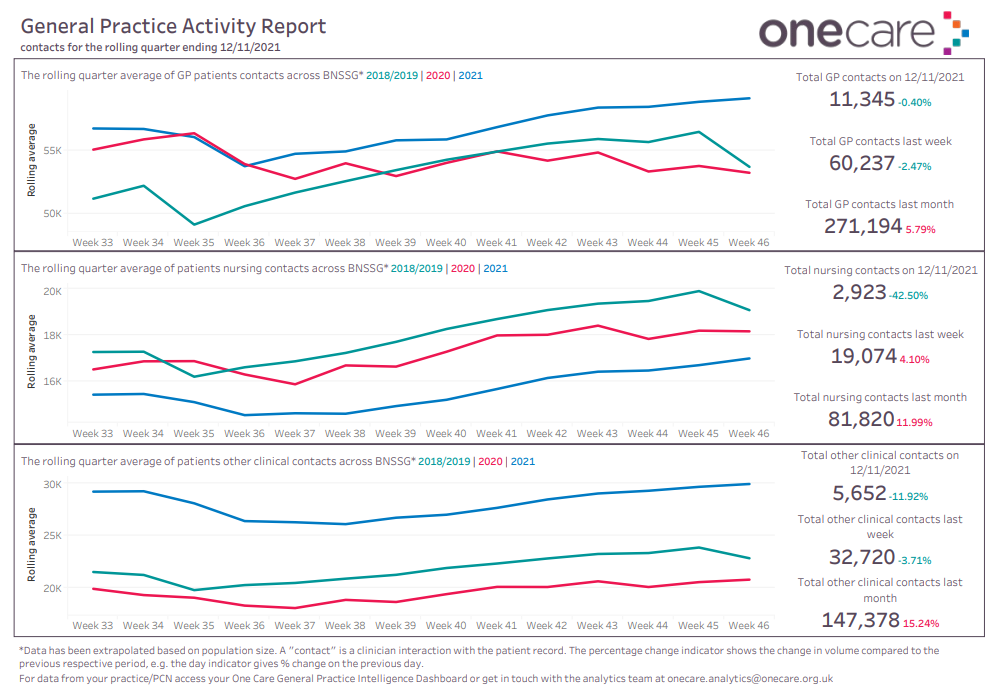
Last week (8-12 November), there were a total of 112,031 appointments across the 77 general practices in BNSSG.

The number of patients to see a GP was 60,237, which is higher than at any point in 2018/19 or 2020. This equates to 54% of all the appointments that took place over the course of the week.

Meanwhile, there were 19,074 appointments with nurses (17% of total appointments) and a further 32,720 with other clinicians (29% of total appointments).

Click here to enlarge the graph.

GPs, their teams, and patients have faced an extremely challenging time during the pandemic and face-to-face contact has been limited across all NHS services to protect patients from the risk of infection.

As the data suggests, not everyone needs to be seen by a GP. All practices offer appointments with a range of other healthcare professionals, and this ensures patients see the right person for their condition as quickly as possible. The general practice team continues to grow, and practices may offer patients an appointment with a physiotherapist, mental health nurse or pharmacist, among others.

To view the latest data around telephone calls, urgent appointments and flu and mass vaccination programmes representing practices across BNSSG up to 12 November, click here.

Receptionists continue to be a key part of the practice team and the questions they ask are to ensure you are seen by the right person at the right time.

This week is national self-care week and doctors and pharmacists in BNSSG are encouraging people to get ‘self-care aware’ by practicing a healthy lifestyle and familiarising themselves with how to treat minor ailments and illnesses at home.

The national campaign aims to help people to better look after their own health – including self-treating very minor illnesses or injuries with help from pharmacists and the NHS website, taking steps to manage long-term health conditions and making healthy lifestyle choices such as exercising and eating well.

Community Phlebotomy successfully rolled out

One Care has been involved in supporting general practice and system partners to develop a new process for taking bloods in community settings. 

Prior to the Covid pandemic, there were 18,000 bloods taken across general practice and acute outpatient departments every week via the North Bristol Trust (NBT) and University Hospital Bristol (UHB) labs, with additional bloods being done at Weston General Hospital.

For many years, general practice has taken outpatient bloods on behalf of secondary care (hospitals), taking responsibility for both the phlebotomy but also the interpretation, communication and risk holding associated with these blood results.

This has been a significant workload for practices, but they have not been contracted to do the work. It is beneficial for patients to have their bloods taken in general practice as it means they can access care closer to home.

The community phlebotomy programme – otherwise referred to as secondary care bloods – has sought to address the governance of this work, ensuring blood results are returned to the requester in secondary care and to properly resource general practice to deliver this service. Over the last year primary and secondary care have been working together, supported by the CCG, to establish a standard process for this, putting patient experience and safety at the heart of the programme. This collaborative approach saw general practice and the trusts working as equal partners in the design of this new way of working.

The community phlebotomy service was fully launched on 31 October after a soft launch on 1 July, which saw primary and secondary care all working to the same standard operating procedure. Primary and secondary care will continue to work together with the CCG in this new phase of the programme to ensure a smooth transition into this new way of system working and to scope out further potential for development.

One Care have been well placed to support practices in the programme’s development due to the trusted relationships already established with practices.

As an integral part of the working group, One Care was involved in the first aspects of building up the business case for the programme, including initial data collection to confirm phlebotomy volumes and negotiating an item of service fee so practices were sufficiently remunerated for the work.

Throughout the programme, which has supported the outpatient transformation in a clinically safe, understood, and funded way, One Care has provided support for practices, in the form of regular communications, training for practice staff, trouble-shooting issues practices are having and developing EMIS resources to support the programme.

The next steps will see One Care analyse the data being collected to monitor the numbers of secondary care bloods being done in primary care and develop a dashboard to present this information back to practices. This data will also be used to monitor the success of the programme and will highlight any areas for improvement.

GP Collaborative Board Coordinator Rosie Southwell said: “A huge thanks goes to Nicola McGuinness (GP Collaborative Board lead) and Geeta Iyer (CCG Primary Care Development Clinical lead) for their leadership in the programme.

“It’s been really inspiring to see how general practice can influence positive change in the system when we come together with one voice. This has been one of the first programmes of work driven forward by our newly formed GP Collaborative Board.

“Practices have been really supportive and engaged throughout the programme – the feedback we’ve received has been extremely encouraging.

“We have lots of learning to take forward into the future as partners across our system begin to work even more closely together in an Integrated Care system. This is a great example of what can be achieved when we work collaboratively to find a solution that works for our population.”

New data in General Practice Activity Report

In an exciting development, One Care has updated its existing General Practice Activity Report (GPAR) to include a further breakdown of the clinical and non-clinical activity happening in general practice each week.

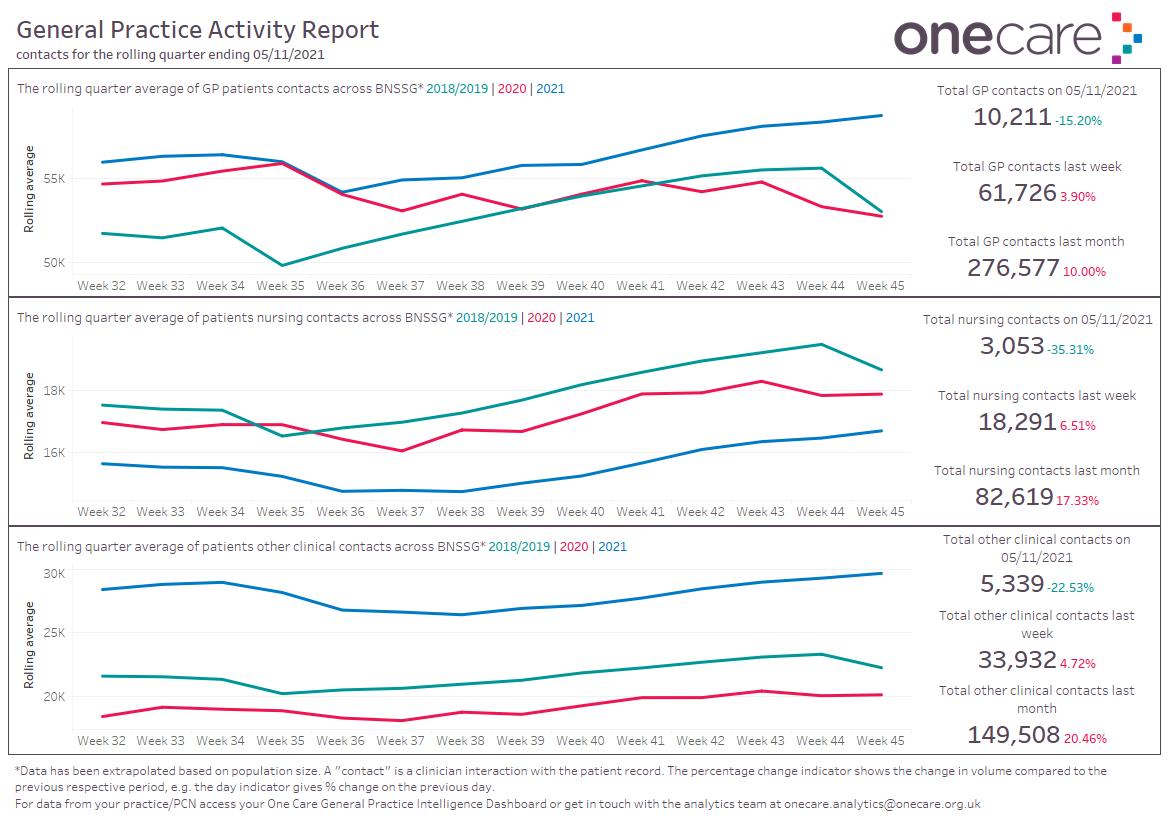
Click to enlarge the graph.

One Care has been producing this report on a weekly basis since April 2021. The report is shared with our system partners, practices and with the public.


GPAR has now been upgraded to provide a more accurate representation of the work happening in general practice and the current pressures being faced.

Click to enlarge the graph.

Further developing the report will enable our system to move towards having a view of activity in general practice that is more like the data presented by other healthcare providers, such as hospitals and community providers, who are able to present rich data about their demand and capacity.

In the new format, clinician activity is now broken down by clinician type and lead time to give a greater understanding of the urgency and complexity of care delivered.

Click to enlarge the graph.

Telephony volumes have also been split to demonstrate incoming and outgoing calls, which highlights the increase in patient demand and telephone consultations. The data can also be compared to historical trends, to show change over time.

Click to enlarge the graph.

View the latest data representing practices across BNSSG up to 5 November here